 CV - Connor van Spronssen
 English
 Dutch
DutchTetris for the Picosystem
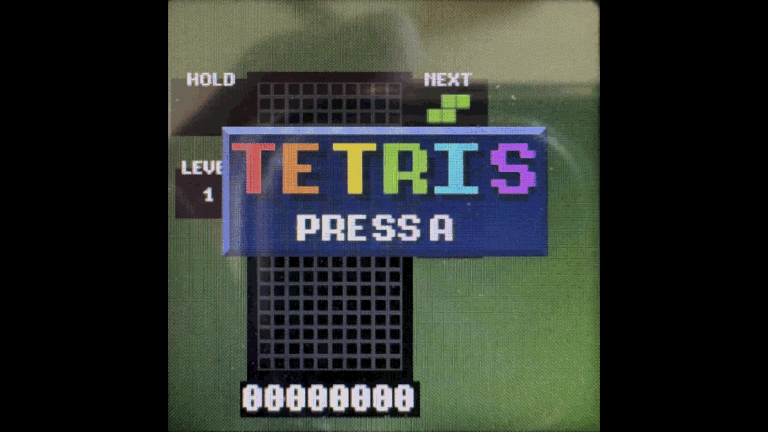
A small Tetris clone made for the Picosystem. It has been built to learn about optimisation and working in very constrained environments, both in computing power and memory.
Why create this?
As someone with an interest in performance optimisation, I wanted to see if I could create an application that would run well on a micro-controller. I did want it to be a game, so I decided to create a Tetris clone. For the hardware, I chose the Picosystem. This is a great little device, and it’s based on the RP2040 microcontroller. This gives me a couple of advantages:
- The RP2040 is still quite powerful for a micro-controller, so I still have some space to experiment
- The Picosystem is a complete set of hardware, so I only have to worry about the software
- The display is 240x240 pixels, which is still quite detailed
Creating the Tetris application
For the programming language, I had several options. Any embedded language could have been used, but two of them are officially supported by the Picosystem:
- C++
- MicroPython
I chose C++, for multiple reasons:
- It more closely fits my goal of squeezing out as much performance as I can
- I’m personally more familiar with C++ than (Micro)Python
- MicroPython has a limitation, which is that the SDK can only render at half resolution
- I want to optimise, but cutting the resolution in half would feel like cheating
https://github.com/Dobefu/picosystem-tetris